Updated for 2026 · Fully private

Family Budget Calculator

Manage your household finances in one place — income, fixed and variable expenses, savings and monthly tracking with charts. Built for olim, expats and English speakers living in Israel: includes Arnona, Bituach Leumi, pension and Keren Hishtalmut. The tool calculates your balance and savings rate, warns about overruns, and helps you know what to cut first when money is tight.

All data stays on your device only — nothing is sent to a server
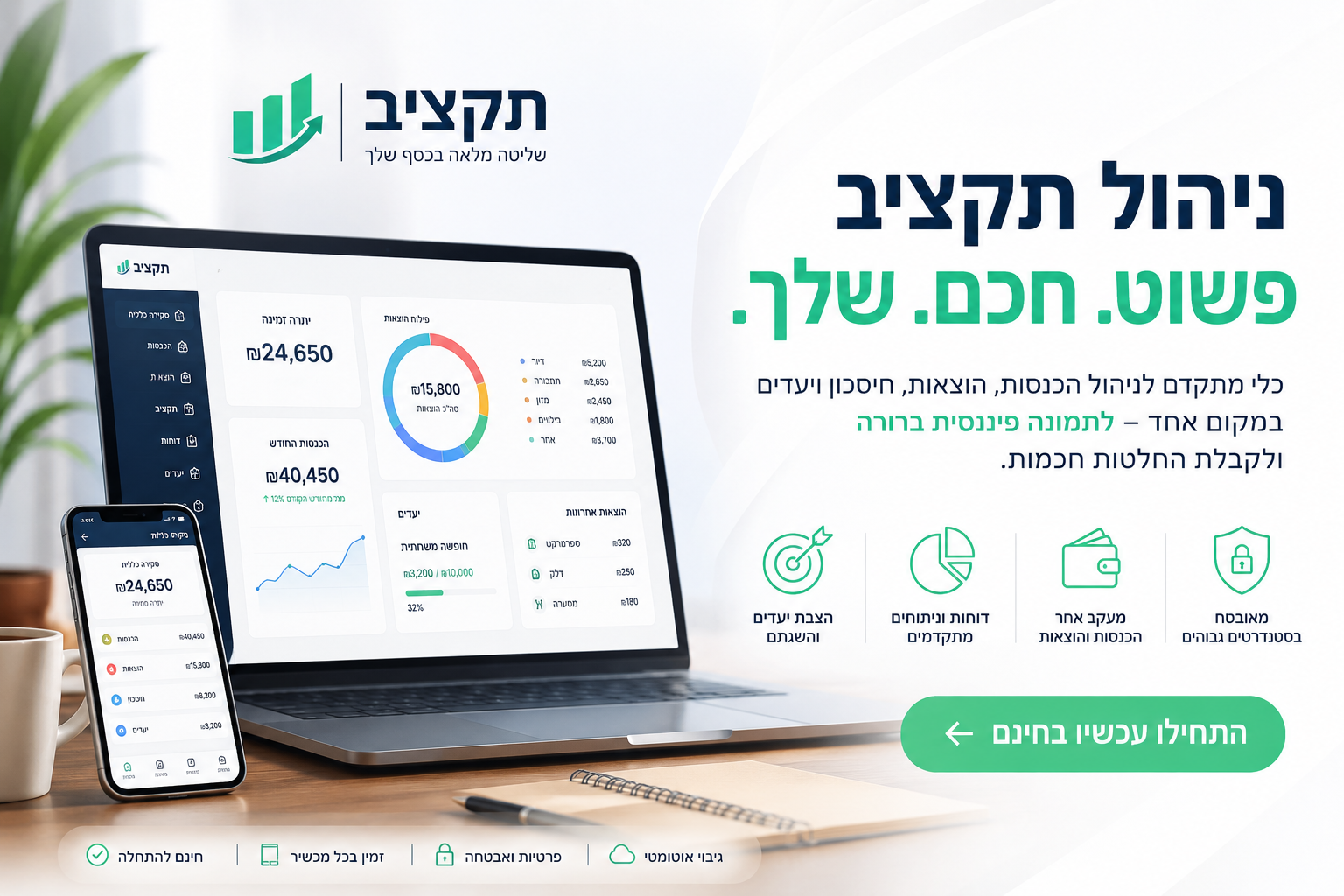
Family budget calculator view — a dashboard with income, expenses, savings rate and charts, on desktop and mobile
Free monthly balance
₪0
Income minus all expenses and savings
Total income
₪0
Total expenses
₪0
Fixed expenses
₪0
Variable expenses
₪0
Savings rate (of income)0%
Recommended target: save at least 15% of your monthly income
Expense breakdown
Total outgoing₪0

Monthly trend — 12 months

Income Expenses Balance

Income

₪0

Fixed expenses

₪0

Variable expenses

₪0

Savings & investments

₪0

Caught in a cash crunch? Here's the recommended order of cuts — the most "optional" expenses first. Each row shows how much you'll save and the running balance. Essential expenses (housing, basic food, insurance) are not included.

Current balance
₪0
Total cut potential
₪0
Balance if you cut everything
₪0

How do you compare to an average Israeli family? Figures are based on the CBS (Central Bureau of Statistics / Lamas) household expenditure survey and rounded — for general comparison only.

CategoryYouNational avg
💡
Daily savings tip
Loading tip…
🔐

Your data

Everything is saved automatically in your browser's localStorage. No information goes to a server — no names, no amounts, nothing. You can export to Excel for a backup, or delete everything with one click.

⚠️ Disclaimer: This tool is for personal planning only and does not constitute financial, investment or tax advice. Comparisons to the national average are indicative and rounded. Israeli tax figures (income tax brackets, Bituach Leumi rates, the 18% VAT and pension rules) change over time — verify current rates with the Israel Tax Authority or a licensed advisor before making significant financial decisions.
Quick guide

How to build a family budget that works

Four principles that turn managing your family's money from a headache into a simple routine — plus how this tool helps you apply each one in Israel.

🧭Step one: know where the money goes

Most families don't know exactly how much they spend each month. The first step in building a budget is simply to map all your income and expenses — fixed and variable. Once you see everything in one place, the decisions become clear on their own.

Fill in your income and expenses in the tool above — your monthly balance updates in real time.

⚖️The 50/30/20 rule

A simple, effective split of your net income: 50% for needs (housing, food, bills), 30% for wants (restaurants, entertainment, holidays) and 20% for savings and debt repayment. It's an excellent starting point for balancing a family budget.

Check the dashboard — your savings rate is calculated for you, with a recommended target of at least 15%.

🛟Emergency fund — first of all

Before you invest, it's worth building an emergency fund of 3–6 months of expenses in a liquid, separate account. It's the cushion that prevents expensive loans and overdraft (minus) interest when a surprise hits — a car breakdown, a new fridge, or a month without work.

Add an "Emergency fund" channel under Savings & investments and track its growth over the months.

🇮🇱Understanding Israeli deductions & terms

New to Israel's system? A few terms olim and expats should know: Income tax (mas hachnasa / מס הכנסה) is progressive — 2026 brackets run from 10% up to 47%, with a 3% surtax on very high incomes. Bituach Leumi (National Insurance / ביטוח לאומי) plus health tax is deducted from salary too.

  • Pension (pension / קרן פנסיה): employer + employee contributions are mandatory for employees.
  • Keren Hishtalmut (study fund / קרן השתלמות): a tax-advantaged savings vehicle, often partly funded by the employer.
  • VAT (ma'am / מע״מ) is 18% and is already included in shop prices.

Salaries in this tool are entered net — what actually lands in your bank account after these deductions.

Savings newsletter

Financial tips for your family — once a week

Join the mailing list and get practical tips on saving, budgeting and cutting expenses in Israel. No spam, unsubscribe any time.

Newsletter sign-up only. Your email is not linked to your budget data (which stays on your device only).

Frequently asked questions

Everything about managing a family budget and about the tool

Is my data stored on your servers?+
No. All data is stored only on your device (in the browser's localStorage). No amount, category name or any other detail is sent to our server or any third party. That's why if you clear your browser history or move to another device, the data won't move with you. It's a good idea to export to Excel from time to time as a backup.
How does the monthly tracking work?+
Each month has its own set of amounts. Switch between months using the arrows at the top of the page. When you move to a new month, the tool automatically copies the amounts from the last month you updated (handy for fixed expenses), and you just update what changed. The trend chart shows the last 12 months you've filled in.
How much should I save each month?+
A common rule of thumb is to save at least 15%-20% of your net income, including an emergency fund of 3-6 months of expenses. The tool calculates your savings rate in real time and turns green when you meet the target. That said, the right ratio depends on your life stage, income and goals — this is not individual advice.
What is the difference between fixed and variable expenses?+
Fixed expenses recur each month at a similar amount and are relatively hard to change in the short term (rent/mortgage, Arnona, insurance, education). Variable expenses depend on behaviour and change month to month (groceries, restaurants, entertainment, clothing) — and that's usually where it's easier to save. In emergency mode, the tool recommends cutting the variable and optional ones first.
What Israeli deductions come out of my salary?+
From a gross salary, your employer deducts income tax (mas hachnasa / מס הכנסה, progressive brackets up to 47% plus a possible surtax), National Insurance and health tax (Bituach Leumi / ביטוח לאומי), and your pension contribution (קרן פנסיה). Many employees also save into a Keren Hishtalmut (study fund / קרן השתלמות). Salaries here are entered net — the amount that reaches your account. The self-employed (עצמאי) pay income tax and Bituach Leumi directly, so add those as fixed expenses.
How do I add or delete categories?+
At the bottom of each group there's an "Add" button — clicking it adds a new row you can name and give an amount. To edit an existing name, just click the text and type. To delete a category, click the × next to it. Every change is saved automatically.
Does the tool work without internet?+
Yes. The tool is built as a PWA — after the first visit you can install it to your home screen ("Install as an app" button) and use it offline. All calculations run on your device.
Chat with me